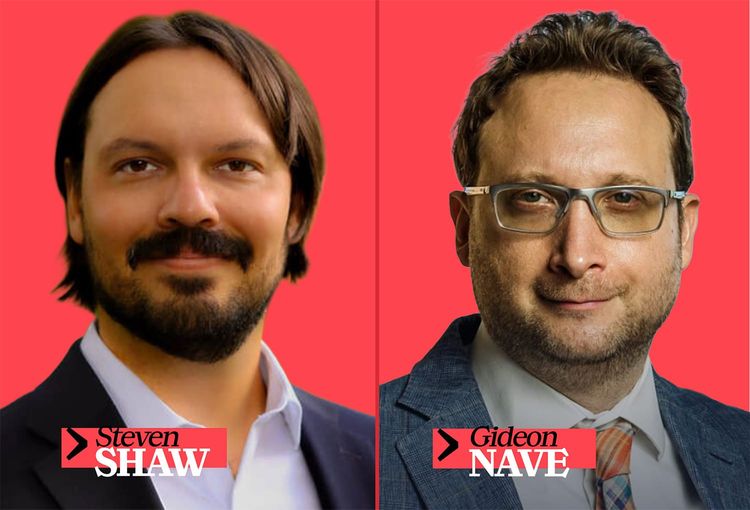
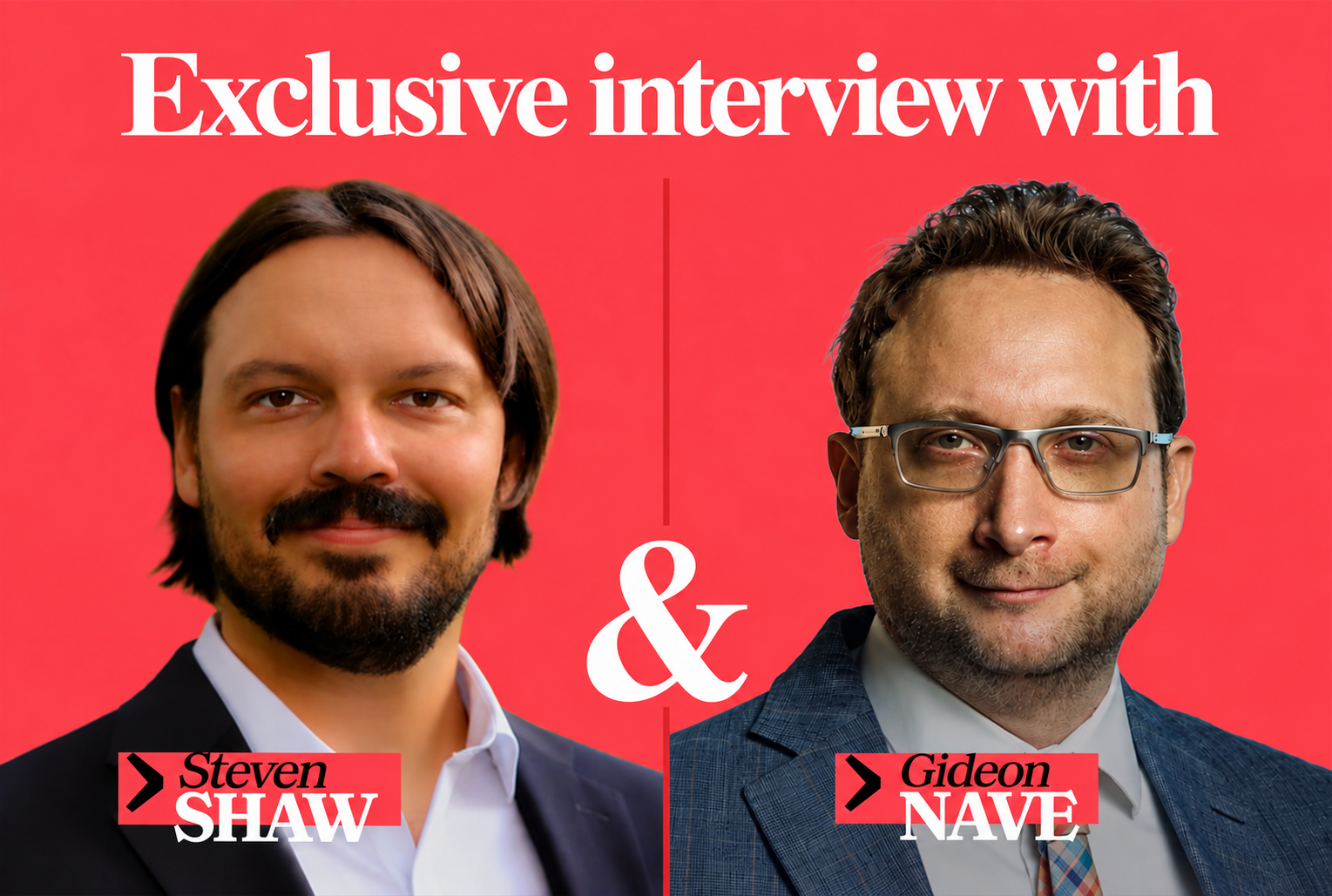
”It can be easy to slip into cognitive surrender when working with AI” – Interview with Steven Shaw & Gideon Nave
We reached out to the researchers at The Wharton School, who are investigating why we give up our cognitive abilities and rely on artificial intelligence.


Ever since Daniel Kahneman’s book Thinking, Fast and Slow (2011) was published, we have known that our thinking is governed by two systems: SYSTEM 1 is responsible for fast, intuitive processing, while SYSTEM 2 is responsible for slow, deliberative thinking.
Two researchers from the Wharton School, Steven Shaw and Gideon Nave, have defined a new “SYSTEM 3” in light of the emergence of AI, which is responsible for cognitive processes located outside the human mind. According to their research, the long-term consequence of this “outsourcing” of thinking – known as cognitive surrender – is not merely that we occasionally give the wrong answer. The bigger problem is that we lose our thinking and decision-making skills if we rely on machines for everything.
Here at the Beyond Taglines editorial office, we’ve been discussing this phenomenon a lot, and we’ve had many questions about the topic. So we reached out to experts on the subject and asked them to tell us a little more about “cognitive surrender” and its various aspects.
Beyond Taglines › Cognitive surrender is a new, well-defined concept. But how new is it as a psychological phenomenon? In the history of mankind giving up "thinking" and surrender ourselves to higher powers have always been a fundamental human tendency. Isn't this "surrender" a defining feature of dictatorships and autocracies?
Steven Shaw › Psychologically, there is a resemblance between cognitive surrender and more familiar forms of deference to authority. Humans have always relied on other people (experts, leaders, institutions, even ideologies) to tell us what to believe or what to do.
What is different in our definition is that cognitive surrender specifically involves artificial cognition.
We are surrendering judgment to a system that can itself generate an answer, explanation, or recommendation and has its own non-human capabilities, biases, and failure modes. It also raises a more fundamental question embedded in the word *cognitive*: is thinking necessarily something that happens inside a human mind?
Technologies that can generate integrated artificial cognition (like LLMs) change the scale and character of deference. If I defer to a physician, lawyer, or other expert, that authority is generally domain-specific. An LLM is available at any moment, responds almost instantly, and can give a fluent and confident answer about virtually anything—from mathematics to relationships to politics. So, there are historical precedents for surrendering judgment, but AI creates a qualitatively different environment in which an external system can potentially substitute for our own reasoning across many domains of everyday life.
BT › How cognitive surrender differs from those "surrenders" when people give up their thinking due to higher powers (whether they are bosses, politicians or spiritual leaders)?
Gideon Nave › We define cognitive surrender specifically as deference to artificial cognition.
In our framework, artificial cognition is external, automated, data-driven, and dynamic—features that distinguish it from organic human cognition.
That also distinguishes cognitive surrender from simply deferring to another person or authority. If I ask my sister, who is a lawyer, for advice, her expertise is domain-specific, she is not available all the time, and the interaction comes with normal social constraints and human biases. AI is different: it is always available, can answer almost any kind of question, and introduces its own distinct biases and failure modes. That makes it possible to outsource judgment across an unusually broad range of domains, at any time. Artificial cognition has different characteristics and properties from other human brains.
BT › With the growing influence of mass media–especially the internet and social platforms–conspiracy theories and fake news spread more rapidly. Can we say that these phenomenons (flat Earth, chemtrail theories, etc.) are also the consequences of cognitive surrender? Or some kind of variants of it?
S. Shaw › I would not describe conspiracy theories or fake news as consequences of cognitive surrender. Those phenomena reflect broader belief systems, biases, and failures of reasoning that long predate generative AI.
The concern is that, if AI systems are not implemented responsibly, the boundary between AI and mass media may start to blur. LLMs could potentially reinforce delusional beliefs or create pockets of conspiracy-like thinking at enormous scale.
Whether we are talking about traditional media, social media, or AI, the basic principles remain the same: responsible communication, verification, and a commitment to factual truth.
BT › Have you observed any other characteristics of those who became "victims" of cognitive surrender? Is there any other pattern that might describe them? Is it predictable who will fall for it–and who will resist?
G. Nave › I would not describe people as “victims” of cognitive surrender. Cognitive surrender is simply the relinquishment of thinking to AI, and that is not always a bad thing. We routinely allow technologies to replace skills we no longer need to perform ourselves. You may no longer remember how to do long division, for example, but learning it still helped develop the underlying logic and reasoning skills.
There are also meaningful individual differences. In our studies, people higher in Need for Cognition and fluid intelligence were less susceptible to cognitive surrender, whereas people with greater trust in AI were more susceptible. So, some people do appear more inclined to scrutinize AI outputs than others—but we are still at an early stage in understanding exactly who will surrender, when, and in which domains.
BT › The Dunning-Kruger Effect, when people overestimate their competence and knowledge, seems to be the opposite of cognitive surrender–however, they might counterpart each other, or go hand in hand. Do you think there's a correlation between them?
G. Nave › They are not necessarily opposites. The Dunning–Kruger effect concerns miscalibration of one’s own competence, whereas cognitive surrender concerns how much scrutiny an external system receives. The two could coexist: someone might overestimate their ability to recognize when AI is wrong and therefore accept its answers too readily. Conversely, someone who underestimates their own competence may defer because the AI appears more capable. We did not test the Dunning–Kruger effect directly, so whether the two are reliably correlated remains an empirical question. It would be interesting to see if they are correlated.
BT › What was the last time (memorable moment) when you realized that you had fallen into the trap of cognitive surrender?
S. Shaw › It can be easy to slip into cognitive surrender when working with AI. Perhaps more interestingly, it can be hard to verify information from AI, and you may not even recognize when you are trusting and accepting rather than independently thinking. Studying cognitive surrender does not make someone immune to it. The phenomenon is powerful precisely because, while it is happening, it often feels like efficiency rather than surrender. And whether adaptive or not is a matter of perspective / depends on the unit of analysis. For example, perhaps you don’t have a skill and you are using AI to upskill and complete tasks you couldn’t otherwise do.
BT › How can we guard ourselves against it? Is it just a matter of staying vigilant? Do you have any practical advice?
G. Nave › Staying vigilant is not enough, because vigilance is effortful and inconsistent. A more practical approach is to build verification into the interaction: form an initial view before consulting AI when the stakes matter, ask for counterarguments and sources, and independently check consequential claims. In our research, incentives and immediate feedback made people more likely to override faulty AI, although they did not eliminate cognitive surrender. The goal is not to reject AI, but to introduce enough productive friction that fluency is not mistaken for truth.
BT › What's your overall take on AI and its usage? How much it can change human thinking? How much it can affect creativity?
S. Shaw › AI can be an extraordinary cognitive resource, but it changes the economics of thinking: answers, explanations, and ideas become nearly effortless. That can expand creativity by generating possibilities and helping people move beyond a blank page. It can also narrow creativity if people blindly accept or allow AI to define both the problem and the solution.
BT › What's your prediction: might there be other "side-effects" of AI beyond cognitive surrender?
G. Nave › There is a growing body of research showing that repeated cognitive surrender may result in deskilling, or never skilling (never developing certain skills in the first place).
The deeper long-term risk may not be that AI can provide wrong answers, but that people stop developing the ability to recognize when an answer deserves scrutiny.
Given how rapidly and pervasively these technologies have entered our lives, it is most certain that more ‘side-effects’ will be discovered in time. Homogenization effects are interesting and starting to pop up in many places…
BT › Are you working (or planning to work) on other AI-based research or project? Would you share something with us–if it’s possible?
S. Shaw › We are interested in working on all things cognitive surrender and Tri-System Theory. We have some projects in real-world domains like medical, financial, moral, and everyday decisions where the context and consequences are richer. Right now, I am also thinking a lot about homogenization of thought and consumer contexts.
Thank you for your time!
Iratkozz fel, és havonta küldünk hírlevelet, amitől sokkal okosabb leszel!